NVIDIA Isaac ROS 5.0 Adds AI Agents to Robotics Development
NVIDIA is pushing AI deeper into robotics with its latest Isaac ROS 5.0 release.
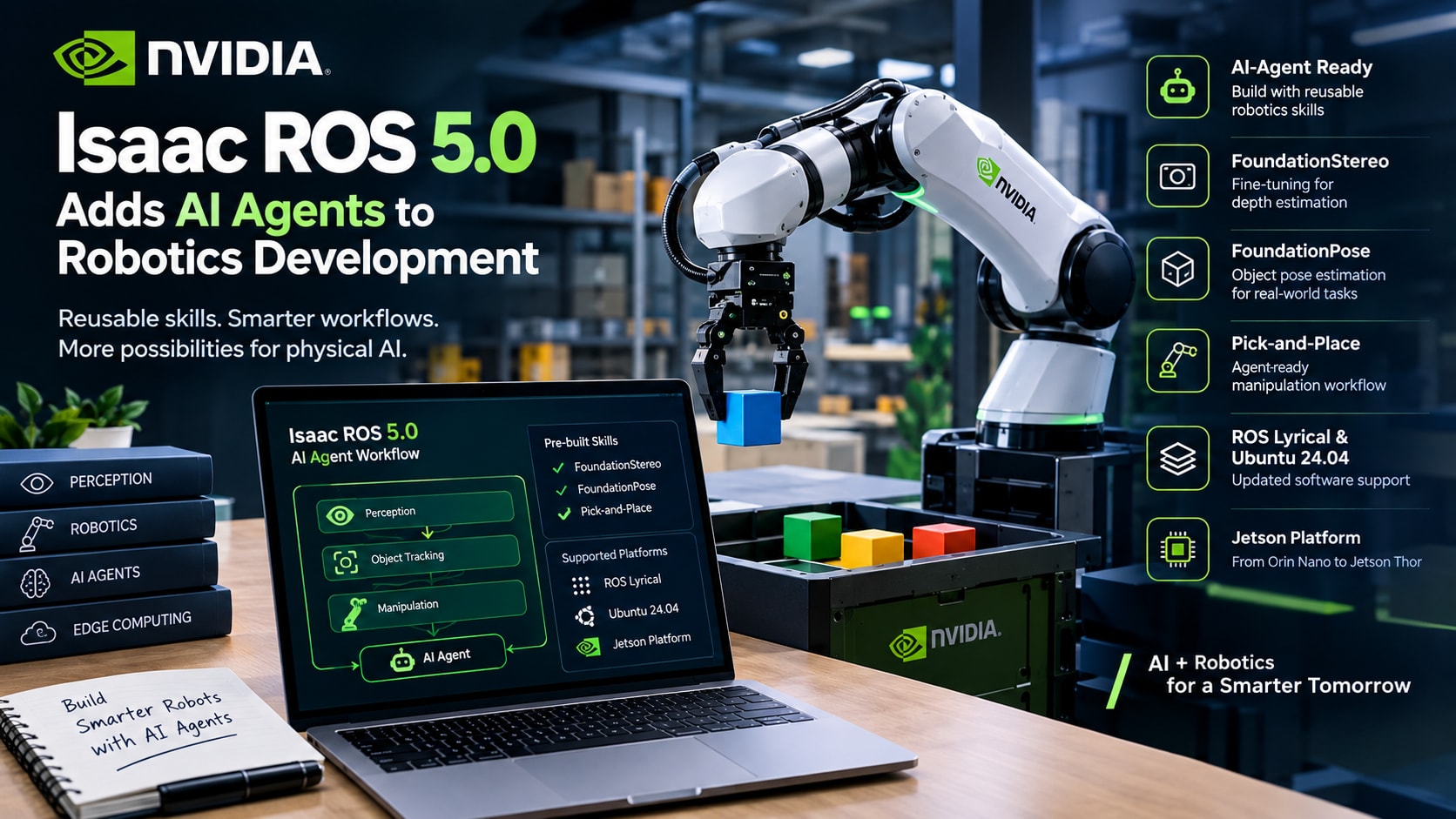
The new version brings AI-agent workflows and reusable robotics skills to the open-source platform, giving developers a different way to build applications for robots. Instead of writing every part of a workflow from the beginning, developers can use ready-made capabilities for tasks such as perception, object tracking and robot manipulation.
NVIDIA announced the release on September 22, 2026. The update also brings support for ROS Lyrical and Ubuntu 24.04.
AI Agents Are Now Part of the Robotics Workflow
AI agents have already started changing how people approach software development. NVIDIA is now applying a similar idea to physical machines.
With Isaac ROS 5.0, developers can use what NVIDIA describes as agent-ready skills. These are reusable components designed around particular robotics tasks.
That means an AI agent does not necessarily have to start with an empty project every time it needs to perform a task. It can work with existing robotics capabilities and documentation to help assemble a workflow.
For developers, the potential benefit is straightforward: less time spent rebuilding common components and more time working on the parts of a robot application that are specific to their project.
Teaching Robots to Understand Their Surroundings
A robot first needs to understand what it is looking at before it can interact with the world around it.
That's where perception models come in.
Isaac ROS 5.0 includes a new FoundationStereo fine-tuning skill. FoundationStereo is designed to help robots estimate depth from stereo camera data.
NVIDIA says the workflow can help adapt the model to a particular camera setup and environment. In practical terms, that could be useful when a robot needs to work in conditions that differ from the data or hardware used during its original development.
This type of customization is important in robotics because a model that works well in one environment may need adjustments before it can be used reliably somewhere else.
FoundationPose Gets an Agent-Ready Workflow
Another part of the update focuses on FoundationPose.
The technology is used for estimating the position and orientation of objects, which is particularly useful when a robot needs to interact with something it sees.
Isaac ROS 5.0 adds an agent-ready inference library around this capability. The aim is to make it easier to bring object-pose estimation into robotics applications and workflows.
For example, a robot working in a warehouse may need to identify an object and understand exactly where it is before attempting to pick it up.
That sounds simple when described in one sentence. In an actual robot, however, cameras, perception models, software and hardware all have to work together.
Pick-and-Place Is Another Focus
One of the more practical examples in the new release is pick-and-place.
A pick-and-place task involves a robot identifying an object, reaching it, picking it up and moving it somewhere else.
Isaac ROS 5.0 provides an agent-ready skill for this kind of manipulation workflow. Developers can therefore use the capability as a building block rather than developing the entire process themselves.
This is where the idea of AI agents becomes particularly interesting.
Instead of AI only helping a developer write code, the software can be connected to capabilities that ultimately control or support physical actions.
There is still a lot of engineering between an AI-generated workflow and a robot safely performing a task, but the direction is becoming clearer.
ROS Lyrical and Ubuntu 24.04 Support
The release also updates the underlying software environment.
Isaac ROS 5.0 supports ROS Lyrical and Ubuntu 24.04. ROS is widely used by robotics developers as a software framework for building robotic applications.
NVIDIA has also highlighted work around data handling in ROS Lyrical, including an interface intended to make data movement between different parts of a robotics system more efficient.
This matters because modern robots can generate a large amount of data from cameras and other sensors. Moving that information efficiently is an important part of getting real-time robotics applications to work properly.
NVIDIA Is Targeting Its Jetson Platform Too
The Isaac ROS ecosystem also extends to NVIDIA's Jetson hardware.
According to NVIDIA, Isaac ROS 5.0 supports hardware ranging from Jetson Orin Nano through Jetson Thor.
That gives developers a way to work with physical AI applications on edge devices rather than relying entirely on a remote server.
For robots, local processing can be useful because some decisions need to happen quickly. A robot cannot always afford to send every camera frame to a cloud server and wait for a response before reacting.
The combination of robotics software and edge AI hardware is therefore becoming an important part of NVIDIA's wider strategy.
Why AI Agents Could Change Robotics Development
The interesting part of Isaac ROS 5.0 isn't simply the addition of another perception model or another robotics library.
It is the attempt to make robotics development more accessible to AI agents.
Traditional robotics development can involve a lot of separate work. Developers have to deal with perception, sensors, navigation, manipulation, hardware and software integration.
If AI agents can work with standardized skills and documented workflows, some of the repetitive development work could potentially be handled with assistance from AI.
That doesn't remove the need for robotics engineers.
A robot operating in the real world still has to deal with hardware failures, unexpected objects, changing environments and safety requirements. Software that looks correct in a development environment can behave very differently when connected to a physical machine.
So AI assistance is more likely to become another layer in the development process rather than a complete replacement for robotics engineering.
The Bigger Physical AI Picture
NVIDIA has been increasingly using the term physical AI to describe AI systems that can understand and interact with the physical world.
Robotics is one of the clearest examples.
A chatbot only needs to produce an appropriate response. A robot has to observe its surroundings, understand what is happening, decide what to do and then physically carry out that action.
That makes the problem much harder.
Isaac ROS 5.0 shows how NVIDIA is trying to bring its AI ecosystem into this area by combining perception models, reusable robotics skills, AI-agent workflows and edge hardware.
Whether these tools eventually make robot development dramatically faster will depend on how reliably they work in real-world applications.
What Isaac ROS 5.0 Means for Developers
For robotics developers, the release offers several new pieces to work with:
- AI-agent-ready robotics skills
- FoundationStereo fine-tuning workflows
- FoundationPose capabilities
- Pick-and-place workflows
- ROS Lyrical support
- Ubuntu 24.04 support
- Support across NVIDIA Jetson platforms
The larger idea is to make robotics development more modular.
Instead of building every capability from scratch, developers can combine existing components and focus more closely on their particular use case.
The Bottom Line
NVIDIA Isaac ROS 5.0 is another step toward bringing AI-agent workflows into physical machines.
The release doesn't suddenly make robots fully autonomous. Building reliable robots still requires hardware, software, testing and careful engineering.
What is changing is the development process.
AI is moving beyond generating text and code and is starting to become part of systems that can see, move and interact with the physical world.
Isaac ROS 5.0 is NVIDIA's latest attempt to make that transition easier for robotics developers, while giving AI agents a more direct role in building physical AI applications.